Until recently I though that having DNS subdomain entries provides enough obscurity thus should it be secure. If your DNS server does not offer transfering domain to another place then any subdomains should be hidden from public sight. Transfers, if enabled (or rather misconfigured) could be made by:
dig -t axfr example.com
Second thing is querying for ANY option, but it does not mean “all”:
dig example.com any
So, with disabled transfers and lack of exactly private entries while quering for any, you would think that you are on a safe side. And that is actually wrong. There are two 3 options on a table:
Someone run crawler and scrap websites for domain names, possibly there are plenty of such systems as I see them quite often in HTTP server logs
Someone hacked your network perimeter and changed your DNS addresses for their own, this affects all the clients connected to such network if you would be able to force such traffic. This is of course a malicious and intrusive procedure, not happening on every day manner.
You are using public/private/provider DNS server and it is saving your requests building a database. Of course it could be either DNS forwarder or resolver or any in DNS query chain with similar configuration.
As far as I know for the most of domains there is no possibility of transfering or exposing too much with “any”. Not every domain was ever present on any other website so it could have been automatically crawled. Is everyone hacked or the most popular public DNS server are involved in building domains list database? There are plenty of subdomains or even domains that are way too complicated to be guessed. I do not think that those information leak from domain registrars but there is a chance.
So there is this domainsproject.org. They say that they use crawling and DNS checks, but I do not bother even to check their code as it seems to be fugazi (fake). How on earth could they check for some random text put in subdomains. It is for sure coming from DNS queries that should stay at those servers safe. Fortunately it does not include every subdomain configured.
Today thinking should be changed a little bit. If you put something on the internet then it is not safe or hidden by default. Maybe I just assumed too naively, and took for granted that people running public DNS servers share the feeling about privacy things as myself.
I’ve been playing around with several devices in a context of running OpenCL code on them. They have one common thing which is excessive heat coming out of GPU and heatsink being unable to dissipate it. I start with MacBookPro3,1. It has NVIDIA 8600M GT, which is known to fail. I assume that it may be linked with overheating. Second example is design failure of Lenovo Thinkpad T420s which has built in NVIDIA NVS 4200M. This laptop has Optimus feature which in theory could detect if workload should be run on discrete or integrated GPU. Unfortunately enabling either Optimus or run-only-on discrete GPU causes extreme overheating up to 100 degress Celcius which makes this setup unusable (it slows down). Last example would be Lenovo Thinkpad T61 with NVS 140M. Contrary to previous examples, this one shows no issues with overheating itself, but is extremely fragile in terms of build quality. CPU has proper heatsink contact by means of 4 screws, but for unknown reason GPU which is 2 cm aside lacks of any screws and is dependent on separate metal clip which puts pressure on heatsink and has its own screw. I find it quite silly, because in case of thermal paste going bad or having loose this one screw it may completely damage GPU. Unscrewing just a little bit this one screw and temperature goes from 50 to 100 degrees risking fire I think….
So, back in a days when manufacturers tried to put dedicated GPU in compact laptops there were several examples of design flaws especially lacking proper heatsink and fans. Nowadays when discrete graphics are way more common on the market it is not uncommon to see several fans and huge blocks of metal giving away all this heat coming out from case because you run game or try to compute something in OpenCL.
Among various computing devices I have there is one that stands out it is NVIDIA Quadro NVS 140M because it supports only FP32 (float) operations, but not FP64 (double). It is generally too old. In OpenCL we have both pow function which takes double and float parameters. The latter is called pown. I use first one to actually benchmark double precision computation.
Model
Year
Core
Unit
Clk
Perf
1k
10k
100k
NVS 4200M
2011
48
1
1480
156/12
13
116
1163
Tesla K20xm
2012
2688
14
732
3935/1312
2
3
24
Intel i7 2640M
2011
2
4
2800
n/a
3
27
281
RTX 3050 Ti Mobile
2021
2560
20
1695
5299/83
2
10
90
Intel UHD 10200H
2020
192
12
1050
422/?
4
19
192
NVS 140M (FP32)
2007
16
2
800
25/-
47
445
4453
The fastest in this comparison is Tesla K20xm which I find a little surprising because it is from 2012 and it wins over RTX 3050 Ti Mobile from 2021. However if we take into consideration that FP64 performance of Tesla is 15 times greater (only 4 x in actual time) than RTX then it should be obvious why it wins.
I have no need to use double to be honest (integer should be just fine here), but it is a great chance to see performance differences between various devices. Using FP32 would be quite difficult to get such a broad range of timings. Using pown(float, integer) changes above table a little bit as we start using FP32 computations (at 100k elements):
Tesla K20xm: 12ms
RTX 3050 Ti Mobile: 3ms
NVS 4200m: 352ms
NVS140M: 4453ms
Now I look at those timings from theoretical performance measured in GFLOPS. Comparing NVS 4200M and NVS 140M we have relation of approx. 6 times (156 vs 25), but timing relation is only just close to 4. So other factors come to play here also. Comparing RTX 3050 Ti and Tesla K20xm we have 1.34 (5299 vs 3935), but timing relation is 4. So actual performance gain is much higher than I would expect comparing GFLOPS measurements.
Getting Tesla K20xm is a steal in terms of FP64 computations as it is on similar level as RTX 4090.
You can put your #GPU in #Proxmox server box and pass thru computational power to virtual machines… just in case you would like to run your AI/ML things alongside your virtualized NAS 😀
Finally I got it working. I think so. This Proxmox installation is simple one, just single node for experiments which is half part. The other part is VM configuration. You may ask, what exactly for do I need GPU in VM? I may need because the hardware is capable of running several additional GPUs and I can use all of them at once in different configurations and even in different operation systems. Just like people do in cloud environments and this setup mimics such thing running server-like computer with datacenter-like GPUs on board. During this test I used NVIDIA GTX 650 Ti which is consumer grade card, but now I confirm to have it working so I will put there my other cards, like NVIDIA Tesla K20xm or FX 5800 with lot more shaders/cores which can be used in OpenCL applications for AI/ML. And you will see how easy is to cross the temperature maximum of a GPU.
I have Intel Xeon E5645 so in my options I put intel_iommu. In case you have AMD or something else, then it should be adjusted. Blacklisting modules, I prefer to keep all of these as you may want to put different cards in your setup. Without this, Debian (on which Proxmox is run atop) will try to load modules/drivers and put your black console screen in higher resolution. If you blacklist these modules, then you will get low resolution output. That is want you should see here at this moment. Totally variable part is vfio-pci.ids (which can be obtained using lspci command). First one is for video adapter and the second one is for audio device. I put both however I will for sure use only the first one.
Other configurations
Second thing to modify:
root@lab:~# cat /etc/modprobe.d/blacklist.conf
blacklist nouveau
blacklist nvidia
Same here, I think that you can have it either here or in GRUB section.
Then, the modules list which should be enabled:
root@lab:~# cat /etc/modules
# /etc/modules: kernel modules to load at boot time.
#
# This file contains the names of kernel modules that should be loaded
# at boot time, one per line. Lines beginning with "#" are ignored.
vfio
vfio_iommu_type1
vfio_pci
vfio_virqfd
Next thing is to apply GRUB options with either of those commands:
update-grub
proxmox-boot-tool refresh
I am little confused as the official documentation (found here) states that you should do the first one, but actually running this command tells us that we should run the second one intead.
To verify it all of above changed anything at all, reboot your system and then:
dmesg | grep -e DMAR -e IOMMU
If you see message saying “IOMMU enabled” then you are good to go further, otherwise some different configuration should be applied. In my case I got some issue saying that my Intel chipset is unstable with IOMMU remapping so the thing is going to be disabled. So there is need to have this “allow_unsafe_interrupts” option I guess. To verify if you have working IOMMU groups:
find /sys/kernel/iommu_groups/ -type l
You should see some entries here.
Virtual Machine
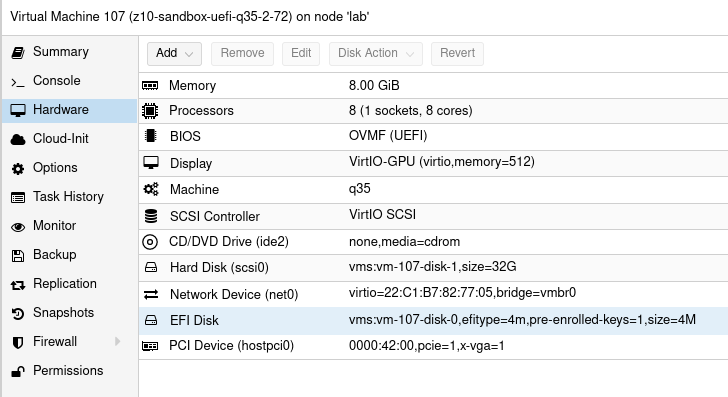
This time I tried 3 VM configurations which is Ubuntu 20 LTS Desktop. There are two main factors you should consider. Different variations may work but it is not fully predictable as you take multiple factors into consideration.
Q35 & UEFI
First one is to use Q35 instead of i440fx. This way you should be able to use PCI-E. I tried it on i440fx and it shows GPU but it is not accessible. Verification process involves the following:
clinfo showing positive number of platforms
nvidia-smi showing process list using dedicated GPU
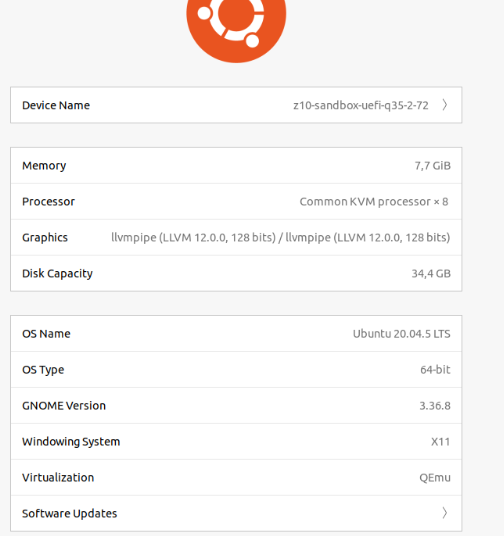
Ubuntu about page saying that we use particular NVIDIA driver (however it is debatable…)
Second thing is using UEFI instead of default BIOS setup, but it requires you to check if your GPU actually supports UEFI. So I tried Q35 and UEFI and this combination allows us to have all of these somehow working. Regarding UEFI I disabled secure boot in VM UEFI/BIOS.
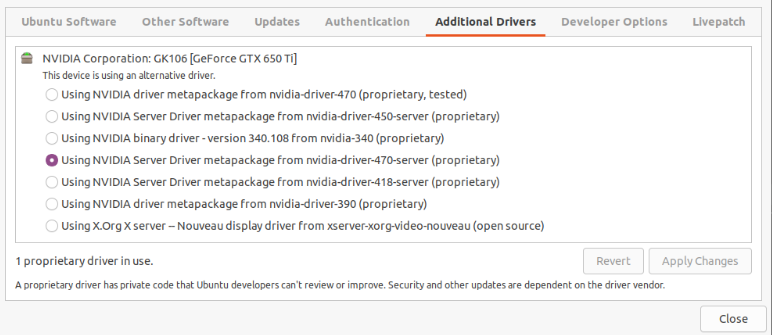
Concerning the driver (NVIDIA in my case) I use nvidia-driver-470-server but other also seems to work. It is weird that Ubuntu about page shows llvmpipe instead of this driver, but the drivers page says that the system uses NVIDIA driver. Not sure who is right here.
The drivers list:
Device resetting
The last thing which prevents this setup from working is to “remove” the devices at boot time (/root/fix_gpu_pass.sh):
Where ID is PCI-E device ID at VM level which can be checked using lspci -n command. Add it to crontab at reboot time (crontab -e):
@reboot /root/fix_gpu_pass.sh
OpenCL verification
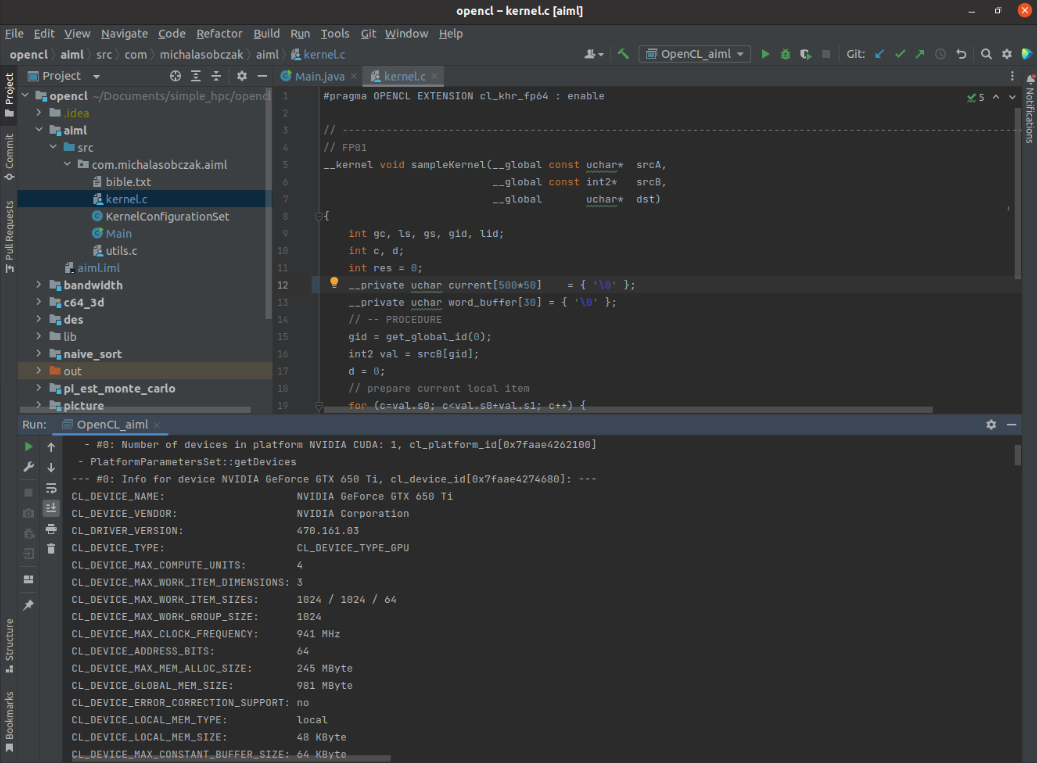
So, if you can see VNC console in Proxmox, your VM is booting and you are able to login, you can install driver, lspci/nvidia-smi/clinfo show proper values then it is now time for a grand last check which is to clone Git repository with my code and try to run it.
cd ~/Documents
git clone https://github.com/michalasobczak/simple_hpc
Then install openjdk-19 and create Application configuration for aiml module having opencl module in your classpath. You may require to rebuild opencl module also. Finally if you are able to see platforms here then you are in the correct place.
I have NVIDIA GeForce GTX 650 Ti placed in my HP z800 as a secondary GPU and the system recognizesit properly and the code runs well. Performance wise I should say that it seems to be fine. I quickly compared NVS 4200M with this card:
NVS 4200M (CL2.0 configuration profile): 30 – 40 ms
GTX 650 Ti (CL3.0 configuration profile): 4 – 5 ms
There is one culprit regarding diagnostics as nvidia-smi does not show GPU utilization and process list, but it shows memory consumption. Increasing local variables size (arrays) has direct relation on memory utilization increase that is why I assume it still works somehow! Maybe even not that bad.
Burning Tesla K20xm
As mentioned earlier after successful setup with consumer GPU it is now time to try a datacenter one. I have this Tesla K20xm which is quite powerful even in today standard. It has plenty of memory (6GB) and tons of cores (2688), even more than my RTX 3050 Ti (2560). Of cource being a previous generation hardware it will be less efficient and will drain more power. And there it is the problem. This GPU can draw up to 235W. I have over 1000W power supply but there is certain limitation on PCI-E gen 2 power output. So the maximum I’ve seen on this GPU during passtru tests was 135W. After few minutes temperature rises from 70 up to 100 degrees Celcius cauing system to switch it off… running nvidia-smi gives me such a error message, asking me nicely to reboot:
So there it is, I forgot totally that this GPU belongs to proper server case with extremely loud fans which I lack actually in PCI-e area in HP z800. This computer has plenty of various fans, even on memory modules, but this area is not covered at all. After computer reboot GPU comes back to life. Besides the problem with the temperature itself, there is efficiency drop after cross somewhere near 90 degrees, it slows down few times and near 100 degress is switches off completely.
You can use OpenStreetMaps on your own hardware. You need to grab map files first, which can be found at https://download.geofabrik.de. Once you downloaded it, install PostgreSQL and enable few extensions:
It may be useful at some point later on especially if you would like to try build your own tile server. Next you need to install osm2pgsql and it can be found in system packages in Ubuntu 22. Then:
Now give it database password and it will start loading. Depening on hardware it might take from few minutes to tens of hours in case of large files like Europe area. You should have something like this:
These are tables with points, lines, polygons and roads. Most of the data is located in the PBF file itself, but few other are calculated on the fly while loading. There is plenty of options for such data. You can use them in some desktop software like QGIS (loading directly PBF file) or setting up complete tile server similar as on the official OSM website.
Data is valuable if consumed or at least identified. For private and corporate usages I suggest installing Redash as it gives options for saving queries, exporting data, creating visualizations and dashboards and also setting up alerts. There are few other interesting features like creating dropdowns and inputs from saved queries or joining resuls from different data sources thru in-memory SQLite instance.
To install Redash, clone the repository. I recommend running Ubuntu 18 LTS server version as it is tested on this distribution. Then chmod a setup.sh file for execution and run it. It will ask for sudo password and going to install all the required things like packges and containers. It is based on Docker so in case of production setup better tweak it a little bit for volumes at least.
That’s all, your Redash should be instantly available to use.
As already stated in my year 2023 plans, there will be some time for graphics programming. Back in the days I was exploring OpenGL but that was way long ago. Nowadays I think to try something much simpler and accessible like for instance WebGL. This library relies on JavaScript for logic and OpenGL ES for presentation layer. So it is hardware accelerated.
But there are some issues with this acceleration. On some computers you can specifically select particular GPU in BIOS/UEFI. However not on every computer. To start with I tried on Lenovo ThinkPad T420s with NVIDIA NVS 4200M. Testing on aquarium demo (which can be found here) I get stable 37 FPS on 5k elements with somewhere around 95 – 99% of load. There is sometimes some performance degradation when FPS count goes as low as 10. GPU and CPU temperature show the same value of 95 degress C. That is way too much. This computer has great advantage over others because it has NVIDIA Optimus feature which gives be ability to switch between graphics chips or let harware to choose itself which GPU should be used at the moment.
My other machine, which is Dell G15 lack such a feature and Ubuntu 22 picks integrated Intel UHD 10th gen GPU instead of heavy NVIDIA GeForce RTX 3050 Ti. So on this integrated chip we have stable 45 FPS, but without any performance drops. I am able to run Firefox browser on “discrete graphics” because I have this proprietary driver but it gives me only 50 FPS, so only 5 more than integrated one. It shows only 30% load on nvidia-smi so it is not doing that much. I tell you even more, on 30k elements there is more FPS on integrated GPU (20 vs 15). I do not quite get it what is going on here.
I still test it on various other harware configurations and it gives more weird unexpecting results.
I’m looking forward for new year’s technology opportunities. I have few ongoing projects which I would like to finish by the end of this year. Here is some brief overview of them:
Data Mining chapter of Simple HPC series
News feed tool as a subproject for data mining
AI/ML project utilizing news feed, OpenCL processing and user-input training
Highly portable system monitoring tool for my day-shift
Video graphics… most probably WebGL/THREE.js
I will try to fit all of these within just around 300 hours available…